Poems and poetry talk

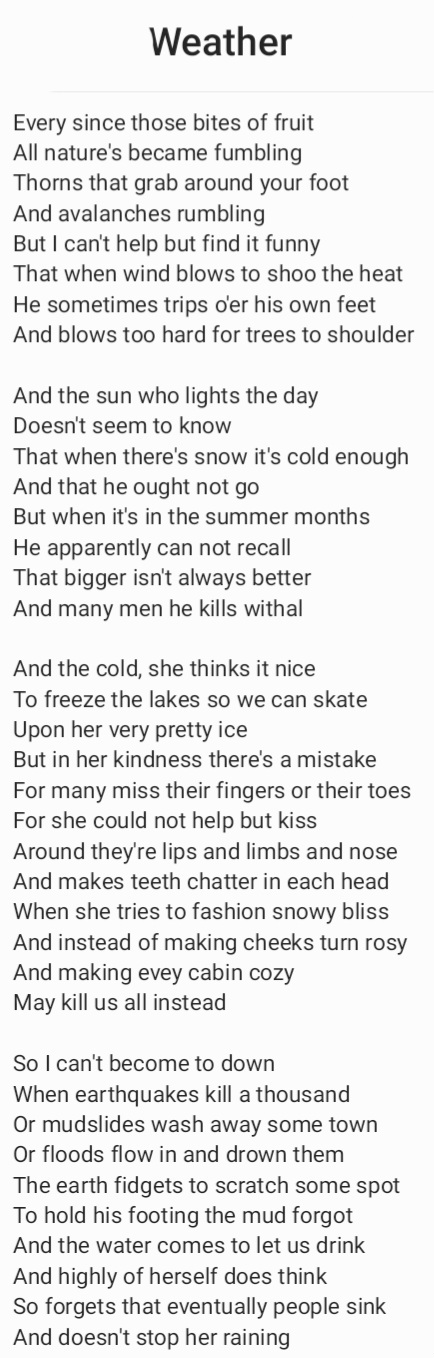
Karl had said something, somewhere on here about wanting this forum to be similar to the inklings. And so, I thought it would be beneficial to have a space dedicated to share and talk of poetry

I think it is proper for everyone to be a poet to some extent, and I try to be, however I seldom write poems and never share them with anyone (Save the woman I’m courting)
I hope to write often enough to be good enough to share my poems unashamedly

Please pardon my prattling or poor punctuation if you find it here

3 Likes

I think more people should write bad poetry. What do you have?

Joseph Brankin
better get crankin’!

Sunlight on pasture
ice shining under the sun
cattle sleep on grass.

(A little impromptu haiku)

1 Like

@Karl haikus are hard
To share them is far harder
Shame hides our efforts

Christmas time is here
Frost and snow gnaw at the door
Joy is not frozen

1 Like

Would you say my name is one syllable or two?

Dang, I guess it could be pronounced with two. I’ll let you be the judge, since it’s your name.


Publishing bad poetry and writing it are different haha
Why do you think more people ought to do bad poetry?

You should strive to make it good poetry, but you shouldn’t not write poetry for fear that it will be bad.

Chesterton says, slightly out of context, that if it’s worth doing, it’s worth doing badly.

A sonnet on your theme

Is there an evil that God did not make?
Or trouble that from heaven didn’t come?
A storm that blows and makes the tree to break
or lightning bolts that make your circuits hum?

Disease or plague that rots your flesh and kills
the young too young to fill out all their years?
The slow goodbye of elders’ minds that fills
the waning days with sorrow and with tears?

Yet all these things are part of heaven’s plan
so we are told and so we must believe.
Not just the good but all the ills we scan
with eyes that see so much to make us grieve.

There is a God in heaven who is love
and all is right at last, so says the dove.

(I can’t write anything but sonnets, limericks, and clerihews.)

1 Like

Well, Speaking of Chesterton…I’ve been thinking of this poem a lot lately.

It’s one in normal conversation, two if someone is searching for you in woods.

That’s right. The vocative is Kárèl.

(Serious note–students of Latin may complain of having to learn the vocative case, the special case that you use when you talk to people, but we have it in English. We just don’t spell it.)

(Note 2: when I watch Korean dramas I note that they have a vocative as well.)

1 Like

I attended an Epiphany Dinner last week for the first time. Journey of the Magi by T.S. Eliot was shared. This was the first time I’d ever heard this poem. It is both a meditation on the three wise men and autobiographical concerning his conversion late in life.

‘A cold coming we had of it,
Just the worst time of the year
For a journey, and such a long journey:
The ways deep and the weather sharp,
The very dead of winter.’
And the camels galled, sore-footed, refractory,
Lying down in the melting snow.
There were times we regretted
The summer palaces on slopes, the terraces,
And the silken girls bringing sherbet.
Then the camel men cursing and grumbling
And running away, and wanting their liquor and women,
And the night-fires going out, and the lack of shelters,
And the cities hostile and the towns unfriendly
And the villages dirty and charging high prices:
A hard time we had of it.
At the end we preferred to travel all night,
Sleeping in snatches,
With the voices singing in our ears, saying
That this was all folly.

Then at dawn we came down to a temperate valley,
Wet, below the snow line, smelling of vegetation;
With a running stream and a water-mill beating the darkness,
And three trees on the low sky,
And an old white horse galloped away in the meadow.
Then we came to a tavern with vine-leaves over the lintel,
Six hands at an open door dicing for pieces of silver,
And feet kicking the empty wine-skins,
But there was no information, and so we continued
And arrived at evening, not a moment too soon

Finding the place; it was (you may say) satisfactory.
All this was a long time ago, I remember,
And I would do it again, but set down
This set down
This: were we led all that way for
Birth or Death? There was a Birth, certainly,
We had evidence and no doubt. I had seen birth and death,
But had thought they were different; this Birth was
Hard and bitter agony for us, like Death, our death.
We returned to our places, these Kingdoms,
But no longer at ease here, in the old dispensation,
With an alien people clutching their gods.
I should be glad of another death.
3 Likes

That’s a good one. What’s the horse about?

Funny you mention that one. That line jumped out at me in the first reading. It seemed out of place. Our group discussed that is an allusion to Christs triumphant victory described in the book of Revelations. Still seems like a wonky line to me.