What I'm Reading

Just saw in the news they found some 24,000 year old dead girl and figured out her diet was mostly just mammoth. I can feel her judging my chicken salad. In all seriousness, grain, and certainly sugar is probably lotus fruit that we can’t put down and has contented us with mavel gazing.

Contemplate how disruptive it would be to the social order if people turned against sugar and grain.

I just finished reading The Intellectual Life by A. G. Sertillanges, O. P. Throughout this work the French Dominican has wonderful thoughts on a life of intellectual pursuit. I have included a few that hit me strongly today.

“We must not lean on ourselves; but to God within us we cannot accord too much trust. We never have too high an idea of the self, if it is in the divine self. Besides we may expect a permanent contribution to our resources from those who initiate us into intellectual work, from our friends, and from our fellow-workers. We have the men of genius on our side. Great men are not great for themselves alone; they bear us up; our confidence is implicitly grounded on their existence. With their help, we can make for ourselves a life as great as theirs, except for the disproportion between our powers and theirs.” Page 258

Reading this reminded me of Adler in “How to Read a Book”, he also encouraged his readers that contact with the great minds would ultimately be beneficial. I also love Sertillanges encouragement of his readers to trust first and foremost in God. After all the creator created you for a purpose, trust in that.

“Every individual is unique: therefore every fruit of the spirit is unique also. What is unique is always precious, always necessary. Let us not fail God, and God’s success will in part be ours. That can console us for our inferiority, and if we produce anything, encourage us in face of the deluge of books.” Page 259

Just beautiful.

2 Likes

My wife and I are reading Wuthering Heights. This is her first time with the book, and my first time in a long time.

When I was young and first read the book, I had liked Heathcliff. Now I loathe him. I had remembered the book like it was about passionate love. Now, it’s more like a horror story about two nice families ruined and terrorized by a gypsy psychopath. I do not believe Heathcliff has a single virtue, and I am embarrassed to have ever liked the character. Everyone in the book is terrible. It’s great fun.

2 Likes

It sounds better from your description!

1 Like

Hey, I am a surviving member of the OGB diaspora myself, also with a group of three who meet regularly. We’re on Physics now. What are you guys reading next? Perhaps we could connect. At least on occasion. We are considering Plotinus next but not sure.

@Eolson here is our current schedule. We decided to break up the philosophy and theology for us. We finished up Plotinus two months ago and then did Confessions last month. If you are interested I can talk to Erick and Rainy off line and work on getting everyone connected.

We snagged our reading list from the OGB Diaspora and supplemented things we felt we missed or were curious about.

Physics - Aristotle Complete Works of Aristotle, Volume 1- book 1-4 December

Theogony and Works and Days; Hesiod Oxford’s World Classics - January 2025

Physics - Aristotle Complete Works of Aristotle, Volume 1- book 5-8 - February 2025

City of God - Augustine- Hendrickson books 1-8 March 2025

Metamorphosis, Ovid; Oxford’s World Classics - April 2025

City of God - Augustine- books 9-16 May 2025

Civil War, Lucan Oxford’s World Classics - June 2025

City of God - Augustine- books 17-22- July 2025

The Consolation of Philosophy- Boethius-Harvard University Press August 2025

Aquinas Basic Works pg 14-35 and 503-674 Hackett edition -September 2025

The Divine Comedy 1: Hell, Dante October 2025

Summa Contra Gentiles- Aquinas- Emmaus Academic Summa Contra Gentiles Books I, pg 1-155 November 2025

Ecclesiastical History of the English People; Bede December 2025

Summa Contra Gentiles- Aquinas - book II, pg 159- 376 January 2026

The Divine Comedy II: Purgatory, Dante; - February 2026

Summa Contra Gentiles- Aquinas - book III, pg 1-322 March 2026

XXX -April 2026

Summa Contra Gentiles- Aquinas - book IV, pg 327-555 May 2026

The Divine Comedy III: Paridiso, Dante; - June 2026
I just finished Hesiod’s Theogony, which was surprisingly short, only 30 pages in translation. As I was reading about the war between the Olympians and the Titans, I wondered if their fight was a metaphor for invasions and cultural change. The Titans were the old gods aka the gods of the original greeks, while the Olympians were the new gods aka the gods of the new greeks who invaded. You even have a fifth column against the Kronos, with disaffected Titans serving in the Olympian cause.

Any thoughts on if the story of the sea peoples’ invasion are hidden in the mythology of Hesiod?

This would be Robert Graves’ interpretation, that you can read the history of the invasions in the stories of the gods.

We’re reading Hesiod for a home group I started with some guys at church. Our group focused more on it as a telling of the human condition, a cosmology, and the connection between the divine realm and world humans inhabit. How do we account for order? For Chaos? What is fundamental; harmony or discord? Love or Strife? What is the origin of conflict? We saw the Greeks asking these types of questions.

I’m reading Machiavelli’s Discourse on Livy.

Very good. I don’t want him to be right, but fear that he is. I had a discussion with one of the seminar clients last night–“Isn’t Machiavelli Italy’s Saul Alinsky?”

I had to think about it. No, I don’t think so. I think Machiavelli has genuine concern for good government, and thinks that his elevation of the ends over the means is for the sake of the greater good. Alinsky is just a bomb throwing anarchist, without a positive goal except destruction of the “oppressor.”

It’s an edition by Castalia Press. Really a beautiful book. It’s a physical pleasure to read it, so much so that I am suspending my usual practice of writing in the book.

This Livy book is very interesting. I’m going to write a few more blog posts about it, and perhaps podcast. I apologize for the late podcast! Have been busy with real life demands.

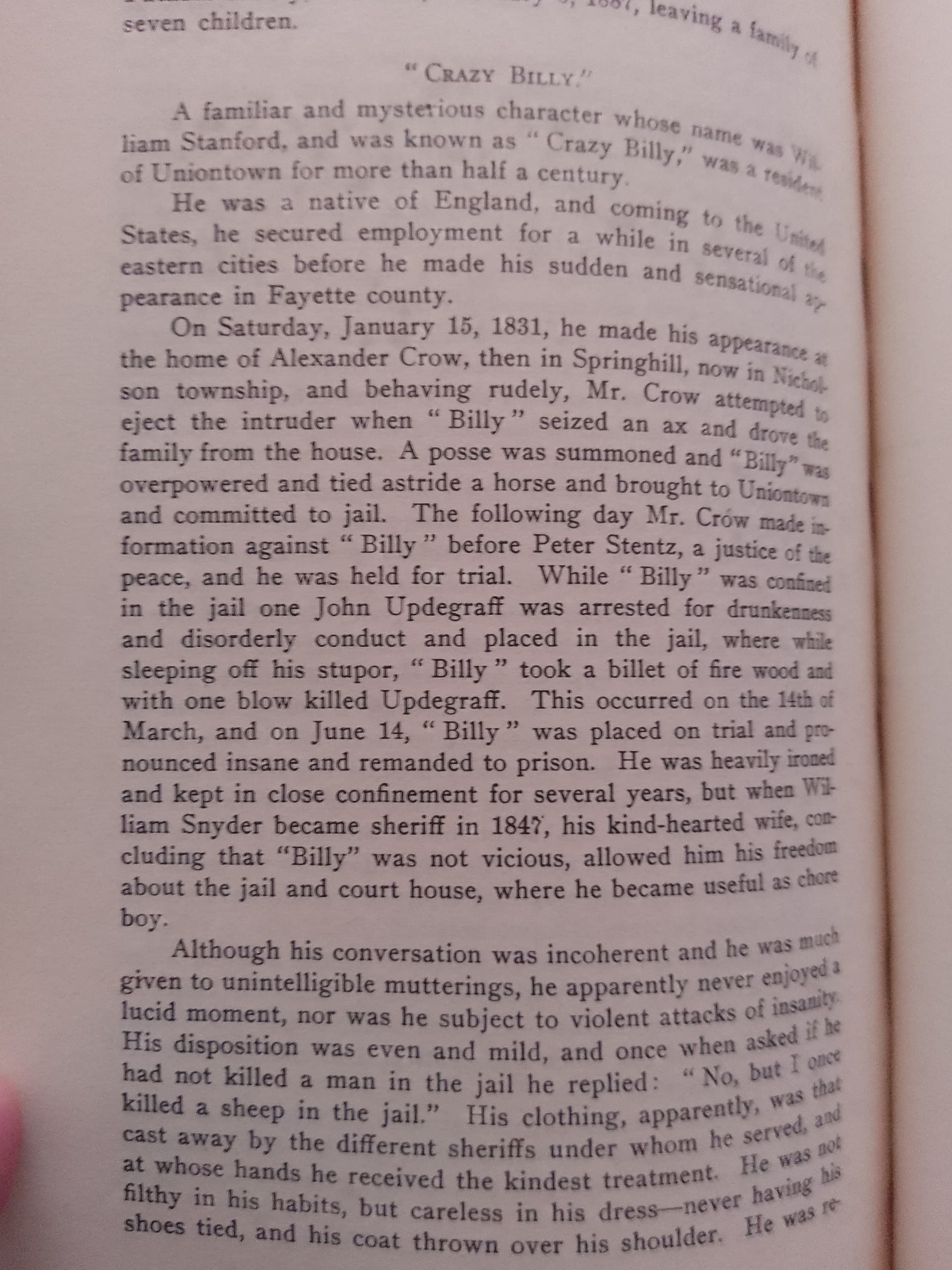
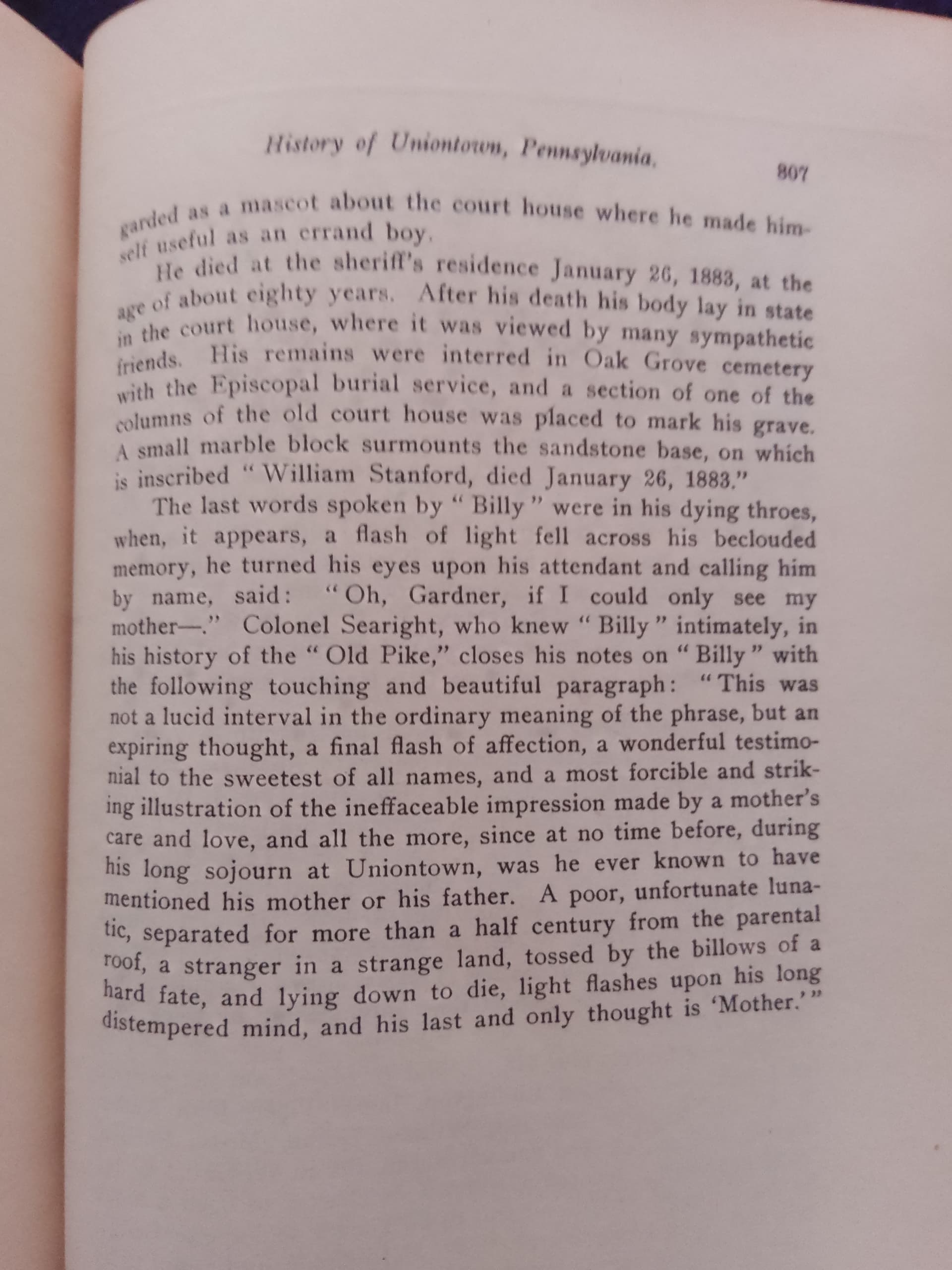
I recently purchased a 1978 edition of the 1913 book “A History of Uniontown: The County Seat of Fayette County Pennsylvania” by James Hadden. It is 824 pages long, plus a sizeable index. It is full of highly localized vignettes into a little town that most people haven’t heard of and don’t care about. There are stories about the construction of roads, the establishment of churches, notable visitors, conspiracies to produce counterfeit bills, riots, secret societies, and happenings of small town life that are usually forgotten.

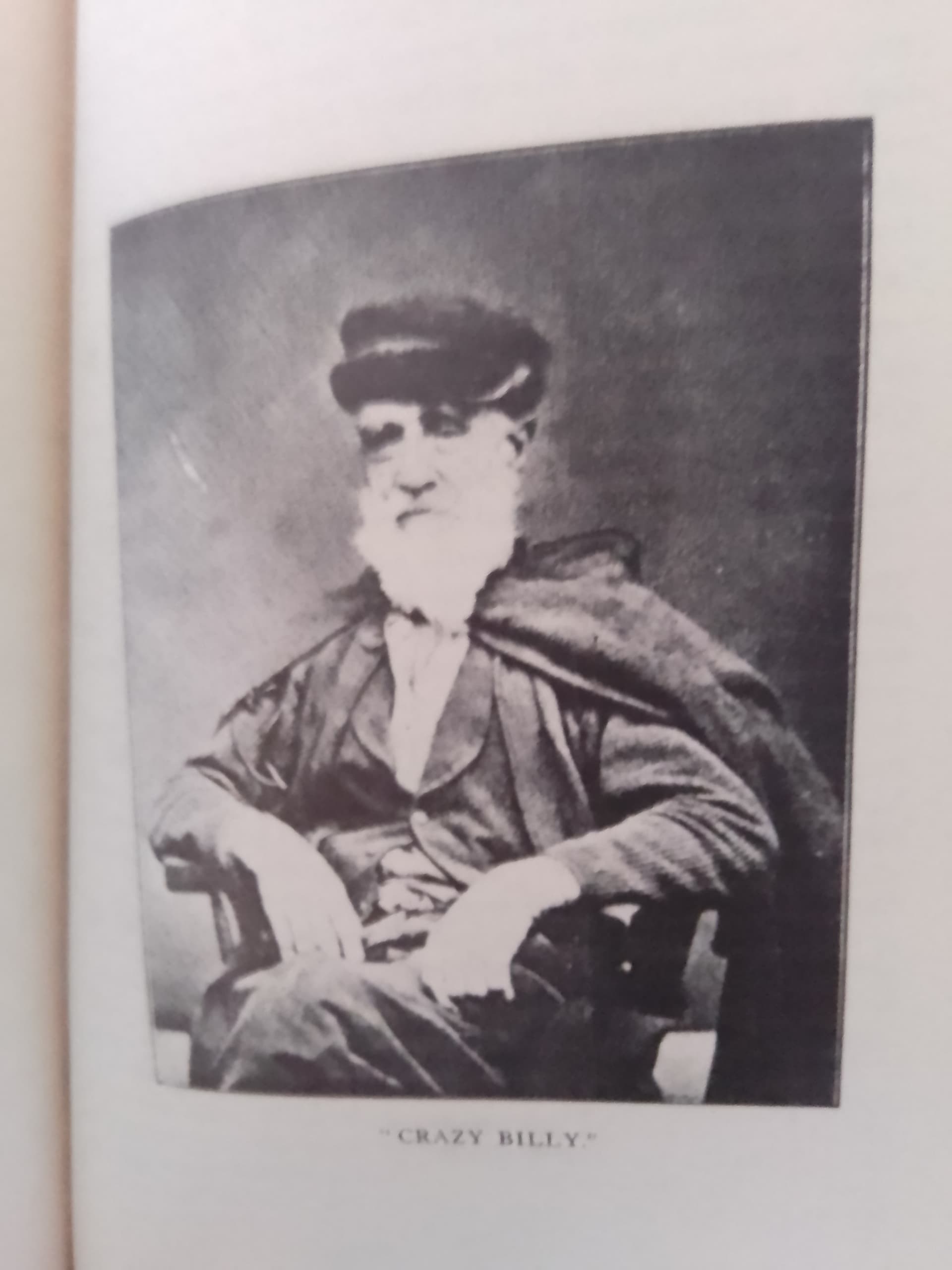
One of the stories is a brief tragedy about “Crazy Billy.” He was not a great man, but he was a man nonetheless, and thanks to James Hadden I’ve had the pleasure of meeting him, pitying him, and loving him.

Crazy Billy is the sort of person we throw away these days. He’s the sort of person we seek to forget, because he bothers us for money outside the 7/11. I’m glad Hadden didn’t let us forget Billy. He deserves to be remembered.

1 Like

Does it mention the byzantine catholics there? It’s a pilgrimage site.

There is a brief section about “St John The Baptist Greek Church.” Is that one of yours?

Most of my reading these days is my evening ritual of reading aloud to my 9 yo daughter, it’s lots of fun for both of us. Currently about to finish Mariel of Redwall. Next we’re going to read Seven Thrilling Tales from the World of Aerwiar. I’ve listened to it and the last half of the book is absolutely heart wrenching, not sure if I’ll even be able to read it aloud. The Wingfeather Tales that it comes from is a FANTASTIC series for kids, one of the best I’ve read with her.

1 Like